old header - feb 2023 in hong kong to discuss how much has changed since dec 2019 death of abed and decade of Bangladesh as number 1 cooperation space- will be updating soon - with singapore friends, we have huge cooperations planned new york march 2023 glasgow june 2023 - mail chris.macrae@yahoo.co.uk if your city in middle of scaling cooperations with UN tech envoy office or 23-24 college year buildinup to UNsummit future DUBAI + 2021 Entrepreneurial Revolutions top 12 countdown 2025report.com

1 dhaka : hk hkft singapore  2 oxbridge Netherlands ...glasgow adam smith cop26 november with italy &. 3abc hong kong fintech 4abc seoul and busan 5abc Vienna geneva & Hague 6abc ny state community corridors 7abc nordica
8abc haidian-beijing youth 9abc barcelona rome 10 abc uae stanford & valley ,, boston 12 abc tokyo ER begun 1976 The Economist 1 2
lives matter-can human-tech leap over value chains of shelf -safety*health*education*loveq*finance Economist's Macrae Norman Foundation 17 sdgs Map-Notes G1M.N : G2 M.N : G3 M.N : G4 M.N: G5 M:N

Tuesday, March 31, 2020


Why the future of Hong Kong’s economy lies in digital transformation

  • Innovation and technology advancements are crucial for any economy, especially in the new normal after Covid-19. Companies must embrace digital transformation to survive
  • Government efforts to hasten this transformation deserve support

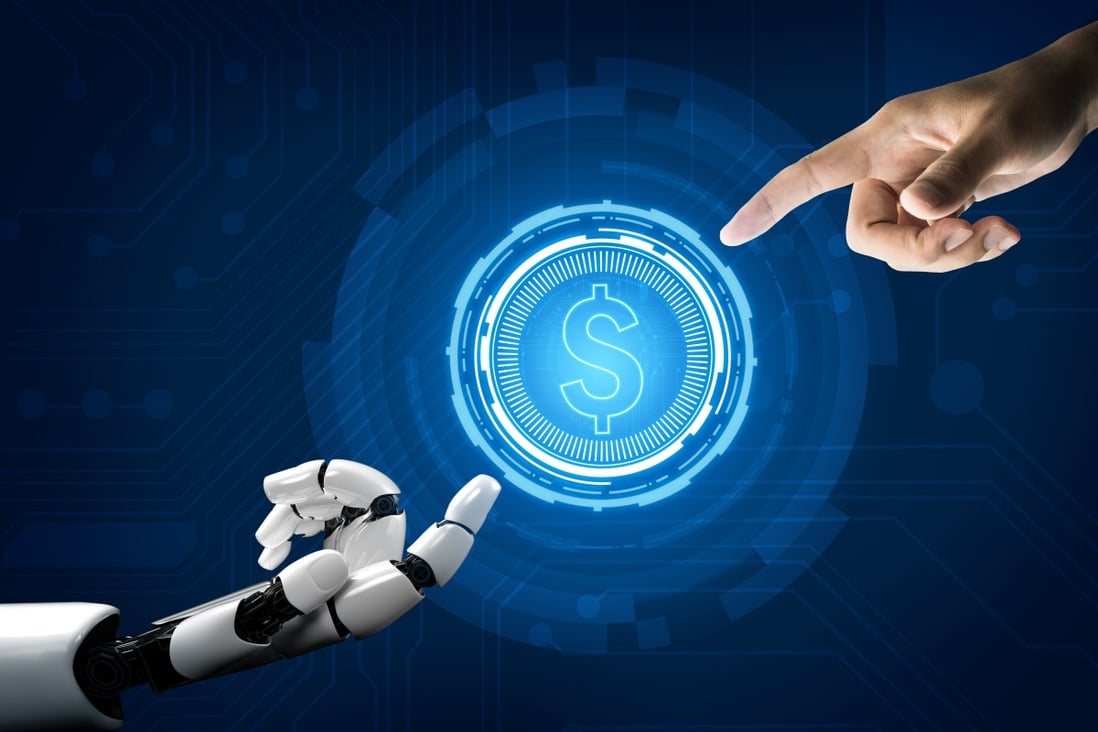
In the new normal, economic survival is tied to digital transformation. Photo: ShutterstockIn the new normal, economic survival is tied to digital transformation. Photo: Shutterstock
In the new normal, economic survival is tied to digital transformation. Photo: Shutterstock

Hong Kong is fast becoming an innovation and technology hub for the region. As early as 1998, Hong Kong established a Digital 21 Strategy. Since then, the city has developed an impressive information and communication technology (ICT) ecosystem, with over 93 per cent household penetration of broadband, and nearly 100,000 people working in the industry.

Hong Kong has followed this up with a Smart City Blueprint in 2017, committing over HK$900 million (US$116 million) to digital infrastructure, and a Smart City Blueprint 2.0 this year.

In addition, both the Hong Kong Science and Technology Parks Corporation and Cyberport provide support for digital entrepreneurs, from funding to incubation. For example, Cyberport is administering a HK$120 million scheme to create jobs and further nurture fintech talent. Last year, Cyberport administered HK$50 million to support 
Hong Kong’s emerging e-sports industry
.

Non-profits such as the Hong Kong Computer Society have been doing their part to empower the ICT community and support tech start-ups and small and medium-sized enterprises. The Computer Society, for example, has been active in disseminating valuable knowledge of ICT through webinars and virtual conferences, with talks by local and global ICT leaders on best practices.

The group’s CIO Board, which consists of chief information officers and heads of IT from prominent organisations in Hong Kong, is a platform to share insights, views, best practices, and experiences, including the latest developments in digital transformation. It has also been advising the government on ICT-related policies and raising public awareness of ICT.

To nurture the next generation of ICT leaders, the Computer Society has a professional and leadership development platform, as well as mentoring programmes. It also has a FACE (Female, Attract, Connect, Engage) Club for women to network and engage in ICT activities, as a way to encourage a more diverse IT workforce and a more inclusive culture in Hong Kong.

The government has given funding to help start-ups and SMEs through these tough times. The Anti-Epidemic Fund includes a 
Distance Business Programme
, a LawTech Fund, rental waivers and 5G subsidies.

Innovation and technology advancements are crucial for any economy, especially in the new normal after Covid-19. For companies of all sizes to survive, digital transformation is a must. All aspects of our daily lives, whether it is work, family or entertainment, have gone digital. If a company does not have a digital presence, it cannot survive. For example, the retail industry and the banking and financial services industry have embraced digital transformation in a very short time.
Hong Kong regulators have also been very quick to accept new modes of digital interactions. According to GlobalData’s recent survey on ICT investment trends in Hong Kong, enterprises here plan to spend an average 39.3 per cent of their ICT budget on digital transformation initiatives in 2020 amid the Covid-19 crisis; that is about 7.7 per cent more than 2019.

As an international commercial and financial centre that needs to work with countries around the world, Hong Kong has always embraced international standards for better integration with international partners as well as in the Greater Bay Area. The adoption of cloud and open APIs (application programming interfaces) has greatly accelerated this process.

The Hong Kong Monetary Authority has been developing an Open API Framework for the banking sector, which will further accelerate fintech development in Hong Kong by allowing easy integration and access and providing consumers with an unprecedented level of convenience and functionality. This framework is being launched in four phases, beginning last year; the third and fourth phases are starting soon. Together with Hong Kong’s new 
virtual bank licences
, this will create a rich ecosystem supporting new nonbank fintech players.
Doing business across borders can be challenging in times of Covid-19, especially for SMEs and start-ups, when travelling and face-to-face meetings are not possible. The government 
launched
 a Covid-19 Online Dispute Resolution Scheme in June to provide mediation and arbitration services for micro, small and medium-sized enterprises, as well as members of the public.

The eBRAM International Online Dispute Resolution Centre, which operates the scheme, is a not-for-profit organisation established in 2018 with support from the Asian Academy of International Law, Hong Kong Bar Association, and The Law Society of Hong Kong. It leverages the latest technologies, such as artificial intelligence, blockchain, cloud and soft robotics, to ensure security and data privacy when handling electronic arbitration and mediation across borders.
Hopefully, with schemes and organisations like these, SMEs will be better equipped for expansion outside Hong Kong, including in the wider Greater Bay Area, and countries in the Belt and Road Initiative, even during Covid-19.

Lastly, what really drives digital transformation is artificial intelligence and machine learning. With streams of data collected on customers and businesses, AI is needed to make sense of data and turn it into valuable insights so as to improve customer experiences and business efficiencies. Given Hong Kong’s research and development capabilities at the Science and Technology Parks and Cyberport, SMEs and enterprises can benefit from Hong Kong’s growing pool of talent in data, AI and machine learning.

Andy Chun is Adjunct Professor at City University of Hong Kong, and Council Member and Convenor of the AI Specialist Group at Hong Kong Computer Society


Sunday, February 2, 2020


cheng sorry if my phone call failed to intro you and emanuel earlier this week while we were downstairs in brookings cafe- you are both ccg fellows- its important henry has people he can trust while summit stuff out of beijing is constrained by virus

complementing your book on china 100 top thinktanks are 10 across japan korea vietnam etc that emanuel http://www.asia-instiute.org  has helped found

cheng please phone emanuel 1 (703) 850-7794
 in next 10 days before his next trip connecting seoul shanghai and tokyo

one of the interesting things of emanuel tanks is that each has student exchange groups that come and visit each other- cheng i really think the students you mentir can trust that emanuels linkedin students care about all of asia win-win -cheng are you able to introi emanuel to marina or ying ior someone at http://www.thinkinchina.asia/ this remains the only thinktank that puts students in the middle that i have come across- also connections with italy are urgent now as soros green thinktank epicentre is at vatican and needs to converges hos 32 billion dollar education investments in youth

valuetrue.com until the damn virus subsides i am going to remap all positive thinktanks /hubs student movements out of hong kong - this is actually where soros 32 billion dollar convergence of student empowerment is most likely to linkin chinas fifth of the world ideas on sustaining the future until we know who next president is

my friends are well connected with directly ten cent foundations in hong kong - indirectly with jack ma because brac is a funtech partner of his but not yet an edu one Bard College and Partners Establish Global Network to Transform Higher Education

Inline image
chris +1 240 316 8157 washington dc 


Thursday, November 21, 2019

Share Sale

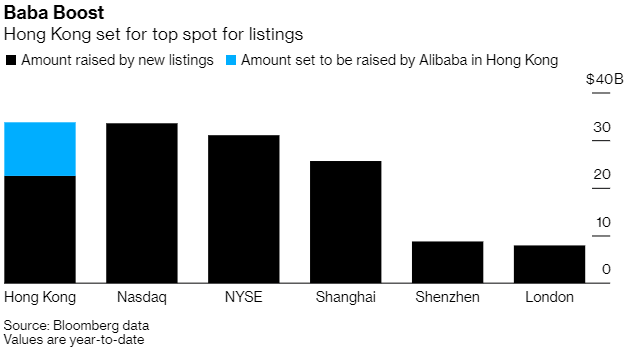
The turmoil that’s gripped Hong Kong for almost half a year didn’t stop Alibaba from moving forward with an enormous share sale this week. The Chinese e-commerce giant raised about $11 billion in Hong Kong’s largest listing since 2010. It could swell Alibaba’s cash pile to $44 billion, about twice as much as fellow Chinese tech titan Tencent has. Some of the places that money could go include investing to grow the company’s business in Southeast Asia or to bolster its efforts in technologies such as Artificial Intelligence.

‘Foothills of a Cold War’

Trade tensions, a shaky outlook for the world economy and the risk of a catastrophic conflict dominated discussions on the first day of the Bloomberg New Economy Forum in Beijing. Former U.S. Secretary of State Henry Kissinger said the U.S. and China were in the “foothills of a Cold War,” and warned that the conflict could be worse than World War I if left to run unconstrained. Microsoft Corp. founder Bill Gates said he was “more passionate about the value of engagement than ever” and worried about those promoting a U.S.-China decoupling. He didn’t see how such bifurcation would be feasible in the technology sphere, where research is published across geographical boundaries. “AI is very hard to put back in the bottle,” Gates said. The New Economy Forum is being organized by Bloomberg Media Group, a division of Bloomberg LP, the parent company of Bloomberg News.